 Skip to content


When planning a garden sauna, choosing the heater is a key decision. The most important part of the decision is whether you want a so-called “wood-heated sauna” or an “electric sauna”.
Finns believe that the key to the best löyly is an atmospheric wood-heated sauna. An electric sauna may, however, suit some people better – the most important thing is that you understand the characteristics of both types of sauna and then choose the heater that suits your own situation.
In this article we look at the characteristics of wood-heated and electric saunas and compare the advantages and challenges of both options. You will also get important information about building regulations, the details of which are especially important when building a wood-heated sauna.
In this article:
A wood-burning heater creates atmosphere and gives good löyly
Made by Ehta According to a sauna study an atmospheric cottage sauna with a wood-burning heater gives by far the best sauna experience and löyly.
Heating a wood-fired sauna is a strong tradition in its own right. The sauna session begins with the grounding scent of wood and lighting the fire in the heater. This ritual gives sauna bathing a unique atmosphere.
Heating a wood-burning heater takes 20–60 minutes, depending on the size of the sauna, the type of heater and the wood being burned. The temperature of the sauna is regulated by the amount of wood burned and the burning rate (by adjusting the air damper).

While the sauna heats up, you can, for example, spend time outdoors, enjoy the company of your loved ones or make a traditional sauna whisk.
Nowadays getting your own garden sauna or cottage sauna is easier than ever, as you can buy the sauna as a turnkey delivery , transported in one piece to your plot. You no longer even need to apply for a building permit for outbuildings under 30 square metres.
👉 Read everything you need to know about building permits for garden saunas >>
Advantages of a wood-burning heater
- The scent of wood and the atmosphere created by the fire and its sound.
- Good ventilation through the flue.
- A wood-burning heater easily delivers plenty of power:
Even a large quantity of stones heats up in a reasonable time. - The heat can also be used to heat washing water.
- You can throw plenty of löyly without the heater cooling down.
- No electrical work is needed for the heater.
- If you like, even the lighting can be handled with rechargeable LED lamps.
- Heating the sauna does not depend on electricity or its price.
Disadvantages of a wood-burning heater
- Safety distances and safety must be taken into account in the design. (Safety distances can be minimised with various types of protection, but a wood-burning heater always needs more space around it than an electric heater. Read more below!)
- Heating requires effort.
- Debris easily collects on the floor, which means more cleaning.
- Burning wood produces fine particle emissions.
- Remember to have the fireplaces swept once a year in buildings used all year round and every 3 years in buildings used for part of the year.
A wood-burning heater in a small sauna is possible but requires careful planning
The more air space a sauna has, the more pleasant it is to bathe in. Nowadays, however, saunas have been optimised to be ever smaller. The sauna room in Ehta's smallest garden sauna has a floor area of 4.8 m².

The height of the sauna affects the bathing experience
The height of the sauna also affects the bathing experience. For the löyly to spread properly and for the air to be pleasant to breathe, the height should be at least 220–240 cm.
A wood-burning heater also needs air space because the combustion process consumes oxygen and produces flue gases.
The height also affects the placement of the benches. The lower the sauna, the lower the benches will be. In that case the bather's feet may not get enough heat.
Finnish folk tradition speaks of the “law of löyly”, according to which your toes should be 5cm above the heater. It is worth knowing the law of löyly, although with the right sauna design the placement of the benches does not need to be quite so exact.
Ehta, for example, uses in its models a protective wall installed together with the heater all the way down to the floor, which warms up as the heater heats up and warms the air rising from the floor. This way your toes certainly won't get cold on the benches, even if in a small sauna they don't rise quite to the level of the heater.
Fire safety must also be taken into account when designing a small sauna
A small wood-heated garden sauna requires careful planning with regard to fire safety. Safety distances strongly determine the design, as the walls and benches must not be too close to the heater. Between the heater and combustible structures there should typically be (depending slightly on the heater) 300 mm on the sides of the heater and 1300mm to the ceiling. Check the exact safety distances in the heater specifications or with the seller.
With a protective wall installed around the heater the required safety distances can even be halved. A fire protection board can also be installed directly on the wall, but it is not a very popular solution in terms of appearance.
Take fire safety into account when building a wood-heated sauna
When planning a garden sauna with a wood-burning heater, remember to take into account the regulations on firebox safety and safety distances. The key regulations concern the flue and safety distances:
- Distance of the sauna from other buildings:
The distance to other buildings must be at least 8 metres and from the plot boundaries at least 4 metres. The required distance can be reduced by building a fire-separating wall. - Installing the flue and chimney:
Using a wood-burning heater requires a properly installed flue and chimney that meet fire safety regulations. - Fire safety and safety distances:
- Make sure that the sauna structures and the distance of the heater from other structures meet fire safety requirements.
- Safety distances can be reduced with a fire protection board or a protective wall installed around the heater. (Safety distances are heater-specific, so check them in the heater specifications or with the seller.)
- The heater must be installed on a non-combustible base, and there must be a spark guard plate in front of the firebox.
- Remember chimney sweeping:
Regular chimney sweeping is mandatory to ensure fire safety. (1x/year, or every 3 years for holiday homes used only part of the year).

An electric heater is an effortless space saver
An electric heater is an easy-to-use option that does not require a flue or chimney. Heating is done with a single turn of a knob, and the sauna design is not restricted by the safety distances that apply to fireboxes. An electric heater with an insulated casing can even be recessed into the bench structure.
There are several types of electric heater
- Continuously heated heater:
The most common type, in which the temperature is adjusted using a control unit and thermostat. The stones are heated by heating elements, and the sauna takes 20–30 minutes to heat up. - Storage heater:
Contains more stones and has an insulated structure. The stones are heated with heating elements, and the heating time is 1–1.5 hours. - Always-ready heater:
Kept constantly on standby at low power, so the sauna can be ready for use quickly by raising the power.
Advantages of an electric heater
- Easy to install and use.
- Allows more versatile sauna layouts and requires less space.
- An effortless heating method that can also be put on a timer.
- No need for a flue or chimney.
Disadvantages of an electric heater
- Requires an electrical connection and an adequately dimensioned power supply.
- Ventilation may not be as good as in a wood-heated sauna, where the firebox circulates the air naturally.
- An incorrectly sized heater can cause problems. For example, a heater with too little power makes it harder for the sauna to dry out, which can even cause problems for the structures.
- Sauna bathing costs can be high, depending on the price of electricity.
- A heater with a large mass of stones gives softer löyly, but when electrically heated it is slow and expensive to heat up.
- A broken or faulty electric heater can cause a fire.
Summary
- The choice of heater has a significant effect on the sauna experience and on the requirements for building the sauna.
- A wood-burning heater offers a traditional atmosphere and good löyly, but requires more effort and compliance with fire safety regulations.
- An electric heater is an easy-to-use and clean option, but it requires the right kind of electrical connection. In addition, ventilation may be weaker and heating more expensive. The sauna experience also lacks the atmosphere of a live fire.
- A successful garden sauna project starts with careful planning and checking the local regulations.
An Ehta ready-made sauna makes your sauna project easy
Ehta's ready-made saunas make your sauna project easy, as we take care of the design and regulatory compliance of the sauna for you. You can still be as involved in the design as you like, as we listen to our customers' wishes at every stage.
- Ehta also supplies a chimney drawing, the heater's certificate of conformity and comprehensive documentation for the sauna.
- For municipality-specific regulations, contact your local building control office. It is the buyer's responsibility, among other things, to ensure that the building is not placed too close to other buildings or the shoreline!
Book a free remote design meeting with Ehta if you need help designing and buying your sauna! You get professional service and speed up the planning considerably – without any pressure to buy.
Heater options for Ehta ready-built saunas
Ehta pre-fabricated saunas and sauna cabins are ready for use, right down to the heater. Once the building is delivered to your plot and installed ready for use on its foundations, you can be in the sauna that very same evening!
Of course, you can also buy the heater yourself if you find one you prefer elsewhere.
Ehta's recommendation is a wood-burning sauna stove, as according to our sauna research, it is by far the most popular option, especially for outdoor saunas.
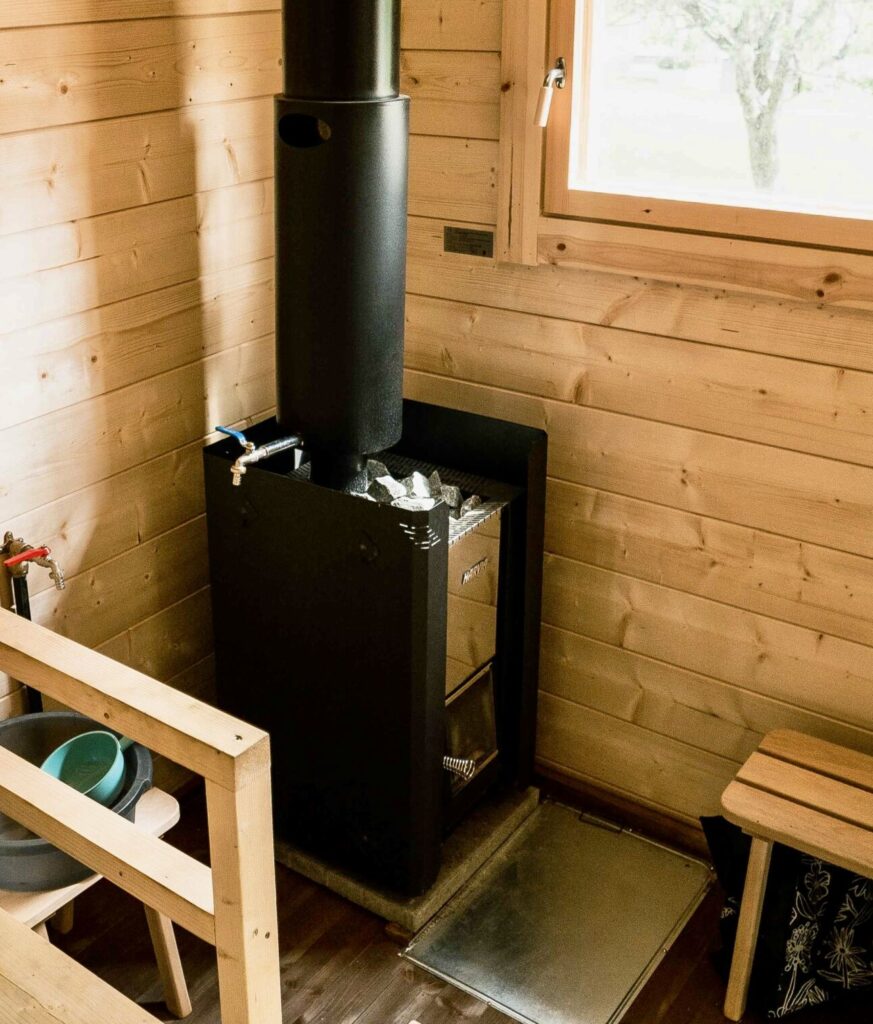
Harvia 16 with chimney water tank
Tried and tested our standard heater, the Harvia 16, is a durable, powerful wood-burning heater. This quick, clean-heating heater meets the wishes of even the most demanding bathers. Cast-iron glass door and stainless steel chimney water tank (22 l).
Harvia 20 Pro heater
We recommend the more powerful Harvia 20 Pro heater, if the sauna is heated in severe frost.
The heater is equipped with a front water tank.
The Pro model has a graphite-black outer casing, stainless steel at the front and a sturdy glass door through which you can admire the flames. The large mass of stones stores heat more efficiently and gives particularly soft and moist löyly.

Harvia Legend 240 GreenFlame heater
The impressive stone capacity of the Harvia Legend wood-burning heater guarantees soft löyly like that of a smoke sauna. The stones held inside the black wrought-iron cylinder also please the aesthete. The fire blazing behind the large glass door burns cleanly, as the heart of the heater is the completely renewed GreenFlame 20 firebox – developed with clean combustion in mind.