 Skip to content

How do you treat a log sauna? How would you like your sauna to look? Natural wood, a subtle light shade or dramatically dark – you choose how your building looks!
Surface treatment has a big impact on the look of a log sauna. The look is also affected by things like the style and size of the windows and whether you choose a modern mono-pitch roof or a traditional gable roof.
A log sauna can be treated with an opaque paint, a semi-transparent stain or a colourless protective treatment. Match the style of your log sauna to the colours of your house or cabin, for example.
In this article you will find a few key tips to help you choose the right products and get a great result.
In this article:
The importance of treating the walls of a log sauna
Treating the walls of a log sauna affects the building's appearance and minimises the effects of weather and sun on the wood's surface.
Bare wood is very prone to changes caused by UV radiation and rain, as well as to various surface moulds and fungi. That is why a log sauna should be treated as soon as it is finished. Rain and moisture take effect fastest in autumn.
The primers soak into the wood and protect it from the elements, reducing the effects of moisture and fungi. Wooden surfaces, especially outdoors, quickly start to turn grey if they are not treated.
The interior surfaces also yellow and get dirty quickly. When it comes to a sauna, the wooden surfaces are subject to heavy wear and tear. Therefore, it is also advisable to treat the interior surfaces as soon as possible.
The condition of the sauna room floor should be checked regularly. The floor takes the most moisture and dirt, so its treatment needs renewing often. Oil treatment, for example, is recommended to be renewed as often as once a year.
If the floor is thermally modified pine, the surface does not require immediate treatment. If you still wish to treat the floor, choose a surface treatment agent suitable for heat-treated wood.
Can a log sauna be left untreated?
A completely untreated log surface is not very common these days. You can, however, leave the outside of a log sauna untreated, as long as you understand what that means for the wood:
- Greying of the logs (due to the effect of the sun's UV rays and rain).
- This is a natural phenomenon and does not in itself damage the log.
- If a structure or any part of it is constantly exposed to moisture, the building's lifespan can be shortened.
- Long eaves, sufficient plinth height and good drainage are particularly important when building an untreated log sauna.
- It takes years to achieve an even grey colour and in the meantime the colour of the surface can be very uneven. If you accept this, the advantage of an untreated surface is that it needs no maintenance.
- Untreated wood surfaces are more susceptible to cracking and uneven wear.
- If you later decide to treat the surface after all, the work is challenging and the result uncertain compared with treating the building for the first time as soon as it is finished.
Options for treating the exterior surfaces of a log sauna
A thin, breathable stain or opaque wood protection, tinted if you wish, is recommended for log walls. It is important that the product contains no plastic and does not form a thick impermeable film, so that the natural breathability of the log wall is preserved.
- Opaque wood protection: Opaque wood protection is an alternative to traditional paint, giving a fully opaque finish and effective protection against the weather. However, it forms a thinner film than traditional paint and leaves the wood grain more visible.
- Stains: A tinted stain, such as Tikkurila's Valtti Color or Teknos, gives a very natural finish that leaves the wood's own surface visible. A stain is very breathable but protects the wood effectively against UV radiation and greying.
Ehta's choices for log buildings, based on long experience:
- Pre-treatment: Tikkurila's Valtti Pohjuste primer is a high-quality, colourless protective treatment that penetrates deep into the wood, makes the surface water-repellent and protects against mould and blue stain. The primer is easy to apply and also improves the adhesion of the topcoat and helps the surface stay clean. A colourless primer does not protect the wood from sunlight, so the surface should be given its finishing treatment as soon as possible.
- Surface treatment: Tikkurila's Valtti stains protect wood against the weather by slowing the effects of moisture and sunlight.
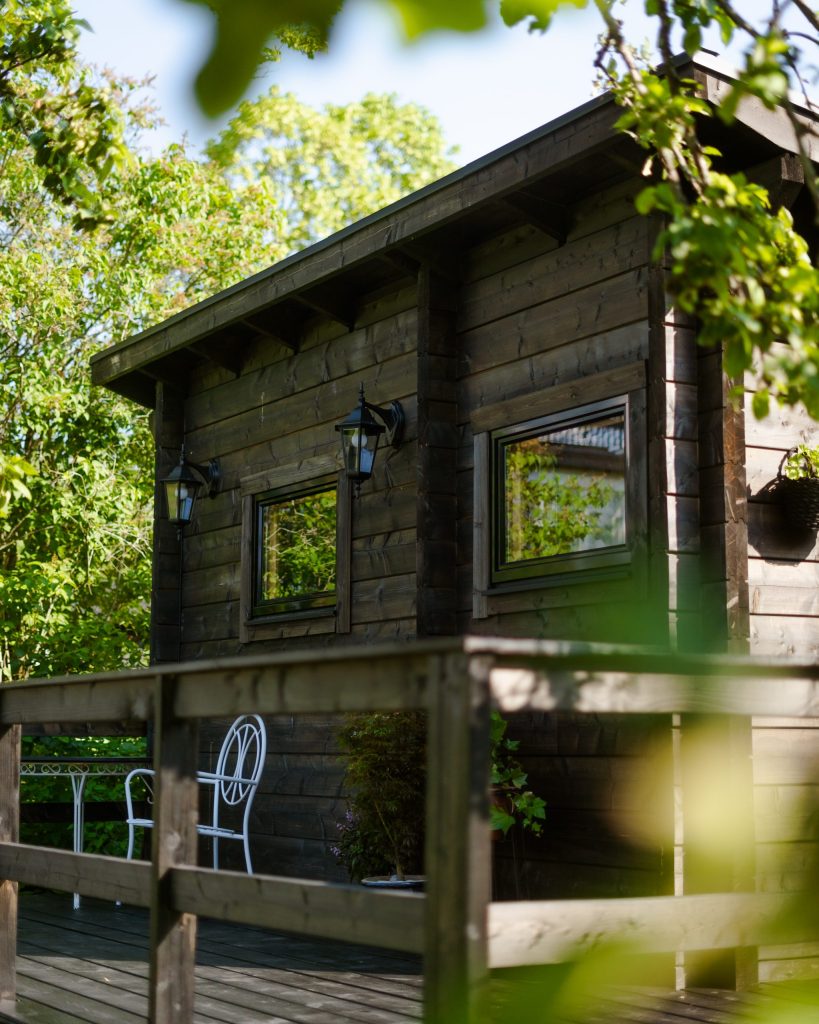
- A popular colour for exterior walls is the dark Piki -stain. A naturally black log sauna building is atmospheric and blends beautifully into nature.
- You can find the colour chart for tinted Valtti stains here. >>
Treating the interior walls of a log sauna
How you want your own building to look is a matter of taste. A log building also looks beautiful left as natural as possible. If you don't want the walls to turn grey, you should apply at least a colourless protective treatment.
Open up the space with light shades, create atmosphere with dark ones
When it comes to treating the sauna room, there is no single right answer. Many people use dark colours, as they create a warm, intimate atmosphere for sauna moments. On the other hand, natural wood is beautiful as it is, without any tint. Light shades, in turn, give a modern, airy feel.
With experience from hundreds of saunas, we have seen and built many different yet successful solutions: light and dark are also combined (e.g. light wood-coloured benches and dark walls), creating an exciting contrast that highlights the sauna's different elements.
Light shades are popular in the sauna lounge
If the building has a changing room or sauna lounge, light shades are at least worth considering carefully.
A white or light-stained ceiling creates a sense of height in a smallish room and makes it brighter.
Also walls are often given a light stain or an opaque white, space-enhancing treatment. In the picture below, the changing room walls have been treated with Teknos's translucent interior paint (3036), mixed into Uula's Ilona translucent paint.
This treatment keeps the log naturally beautiful but takes away the yellowish tinge. To get an even, long-lasting result, two coats are needed indoors too.
Treat the sauna benches sparingly
Never paint sauna benches with ordinary paint, as they will get too hot and can also become sticky. Many surface treatments also release chemicals into the sauna air when they heat up.
The benches can be left in their natural colour and simply oiled with paraffin oil. If you want colour or contrast in the sauna, Tikkurila's Supi Sauna Wax also works very well on benches. Apply the wax thinly, only as much as the wood absorbs.

Protect the log sauna floor straight away
The floors of log buildings are often pine, which naturally yellows over time. A wax treatment is recommended for the sauna lounge floor. Tikkurila's Supi Sauna Wax works for this too. A completely colourless wax protects the floor but does not prevent yellowing. If you wish, you can prevent the colour change with a product designed for the purpose.
In the sauna lounge below, all surfaces, including the floor, have been treated with Tikkurila's Supi Sauna Wax in Tuomenkukka shade.

These days, sauna rooms also often feature thermally modified pine, which is slightly darker in tone and does not yellow. Thermal modification gives the floor natural protection against moisture and dirt, so surface treatment may not be needed at all.
Treating a log sauna – step-by-step instructions
Choosing the right treatment product:
Different products can affect the natural properties of wood, so keep this in mind when choosing a treatment product. Log surfaces should be treated with a plastic-free, breathable product. Hardware stores and other paint and wood-treatment retailers will be happy to recommend suitable options for logs:
- The lounge floor is best treated with wax or an oil suitable for indoor use.
- The condition of the sauna room floor oil treatments must be renewed regularly.
- For the benches, paraffin oil or another bench oil of your choice works well.
- A good alternative is Tikkurila's Supi Bench Protection, a paraffin oil that protects against moisture and dirt. It soaks into the wood, leaves a natural surface and deepens the benches' own tone.
Before you start painting:
- Protect windows and trims carefully, for example with tape and plastic sheeting or cardboard.
- If you are using painter's tape, remove the tape as soon as the paint has dried, as the adhesive surface can dry and stick firmly to the wood, leaving unsightly glue marks.
- If the sauna has already been used, it is advisable to wash it lightly before treatment.
- Then stir tinted treatment products in particular thoroughly before you start, and also every now and then during the work.
- Apply the product along the grain of the wood, one log at a time, from end to end.
- For an even finish, the building needs two coats. The first coat is a little slower to apply, but the second coat goes on more quickly.
- If you use the popular Supi Sauna Wax, the job is easy with a foam brush. Apply the sauna wax in a single coat along the grain, using only as much as the wood absorbs in one application.
Ehta's ready-made log sauna is available treated or untreated
Ehta offers a wide range of surface treatment options, from a protective treatment that leaves the natural surface visible to a rugged dark finish and various light shades. If you prefer, you can also treat the sauna yourself.
The Ehta log sauna floor is made of thermally treated pine, which can also do without treatment.